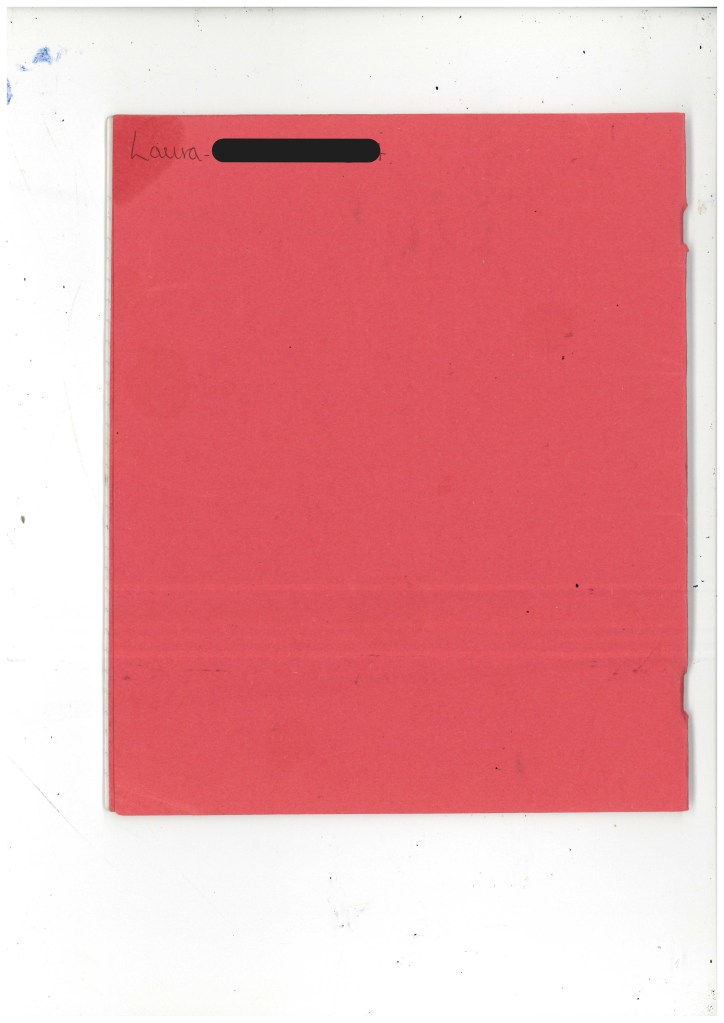
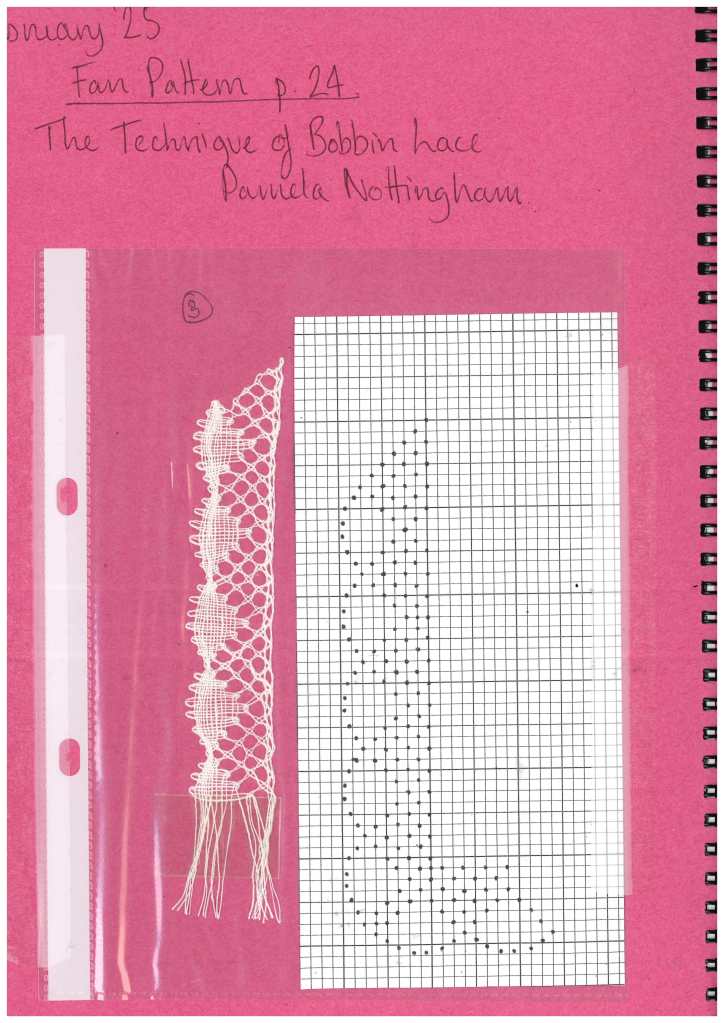
Photocopy of the inside cover of a MA module notebook
While I have been revisiting my old work I realised that the structure of the degree was useful for the bits of me that can struggle to work an idea through to its end point. It seems like the organisation of ideas into modules and projects helps me a lot with progression. The text from blogs I was obliged to keep has allowed me to keep on track with ideas I would otherwise have forgotten.
As I am finishing my MA on my own, I decided to recreate some of that structure to help me finish my dissertation. I will continue to keep a record of my progress on this blog and I will organise my work into four distinct ‘modules’:
Skill – learning and progressing through lace making, plus any other skills I decide to learn.
Critical and Contextual Studies – exhibitions I visit, theory I read, the context of my work in amongst other art and the world today.
Studio – practical and creative work I make putting ideas into practice, reflecting on that work and anything like a crit I am fortunate enough to get.
Artist – anything organisational or administrative like applications and ADHD proofing.
This helps me in a way I find it difficult to articulate. It allows me to put different tasks in different ‘buckets’ and then dip into each bucket when the time is right. It helps me when I don’t feel creative to still push the project forward with another type of task. It removes barriers between me and doing things and keeps the plan clear in my head.
Five years after starting I have finished my project for the Counter-mapping module on the unfinished MA. I began this in April 2020 and finished the physical act of crocheting the time spent in the first lockdown in May 2020. I struggled to document and write about the work at the time but revisiting the MA and my collected documents from the course has helped me contextualise the work differently and probably better than I would have been able to contemporarily.
Given that I am not submitting this to someone grading against a marking scheme, I have taken some liberties with the form and content of the accompanying ‘essay’ for artistic reasons and neurodivergent ease.
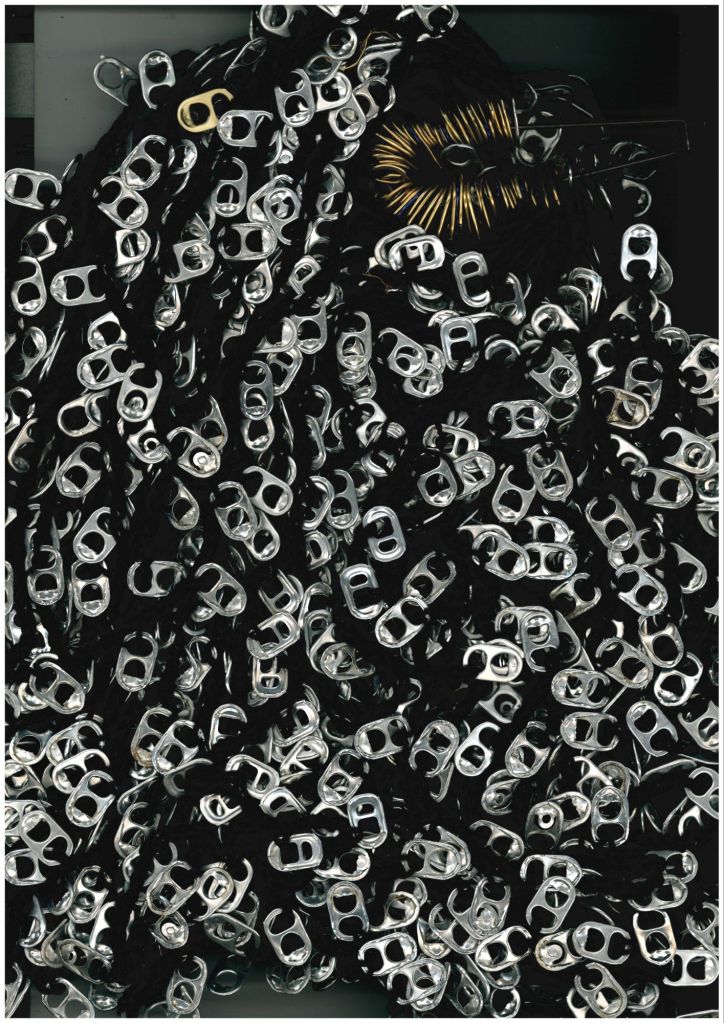
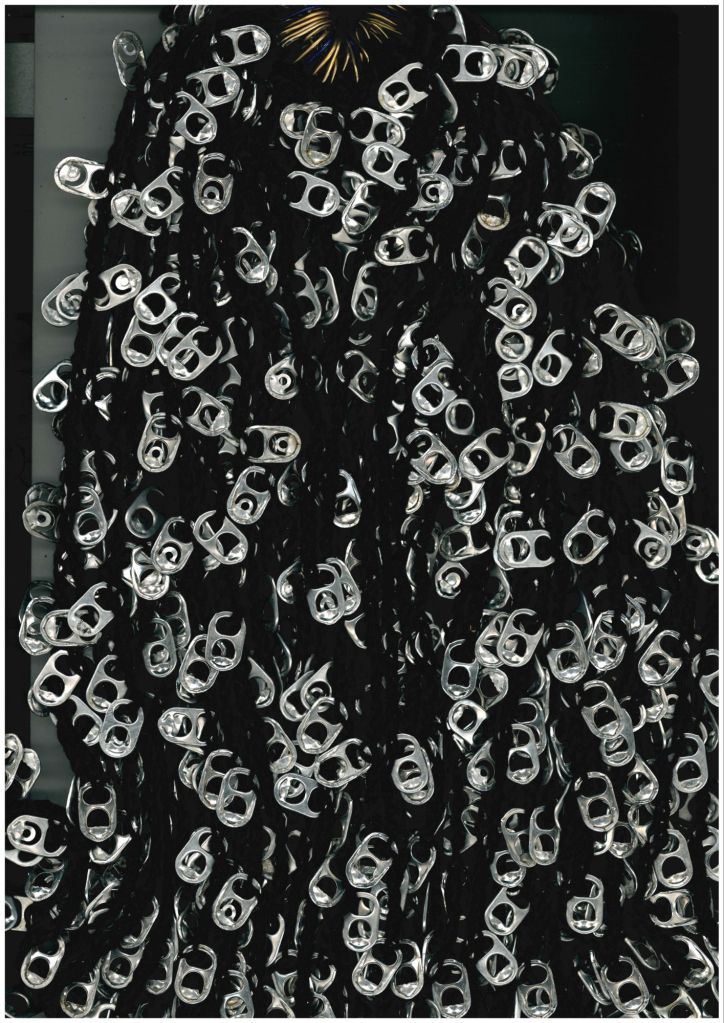
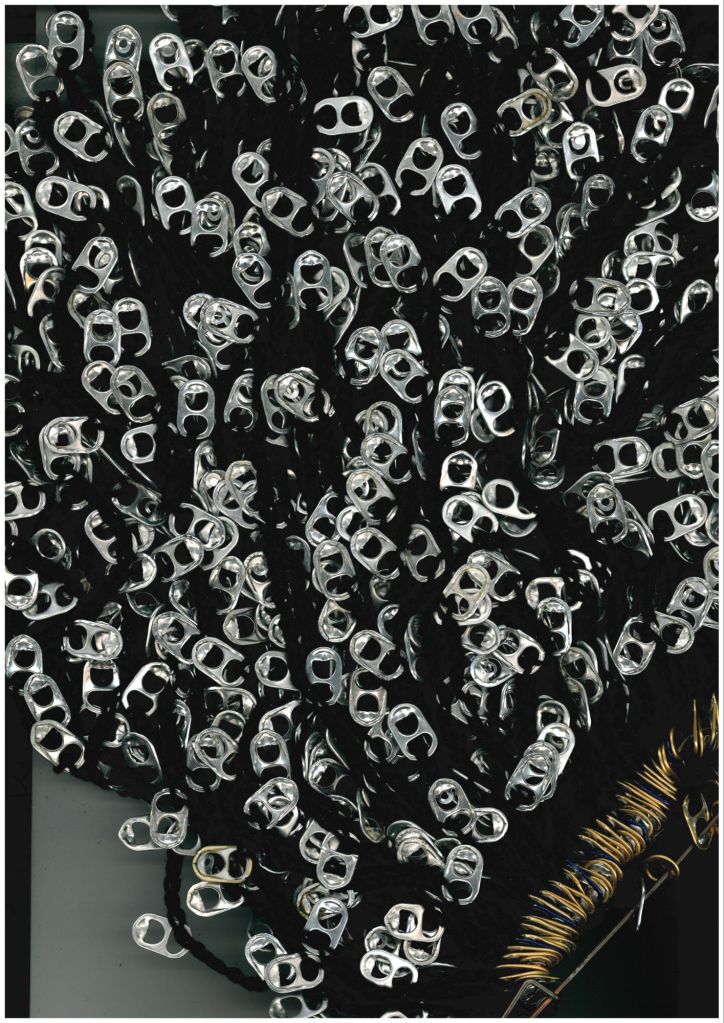
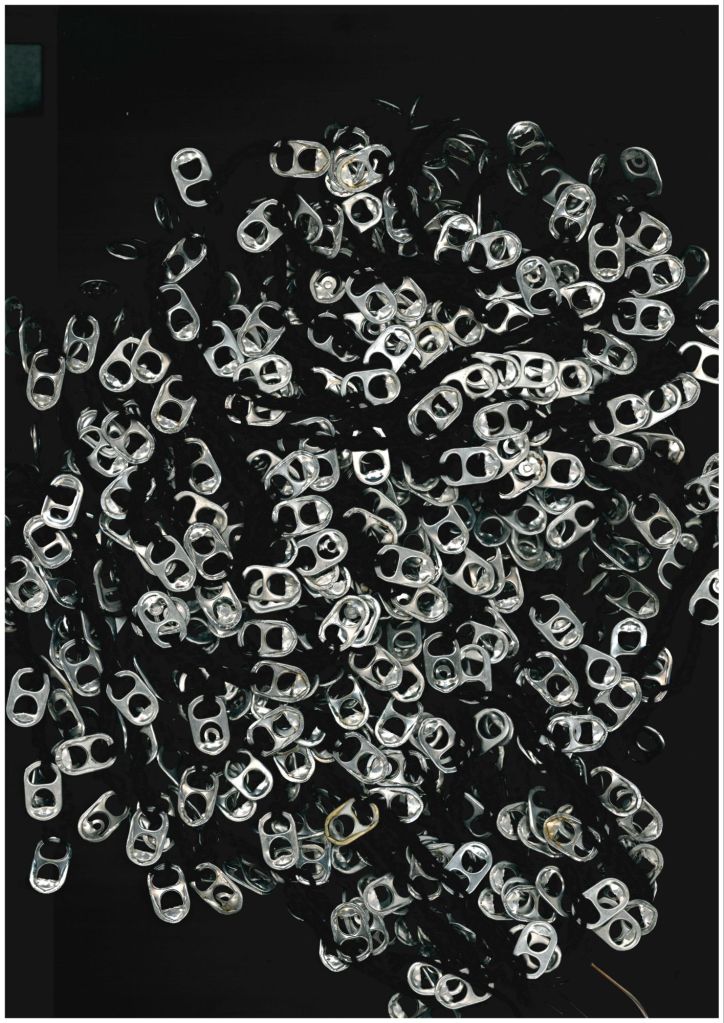
I have an aversion to photographing the timepiece and photocopying made more sense to me. I am very satisfied with the results. It looks confusing and smothering like the pandemic. Repetitive and monotonously chaotic like the lockdown. Very detailed and flat like life felt for a while. While waiting at the photocopier I momentarily used the hook to hang the timepiece from my back pocket. It hung there, heavy enough for me to feel, and a bit strange, like the ghost of the experience. The metaphors have really been writing themselves with this piece of work and it feels honest.
After deciding to finish the project I had to find everything. All the notebooks, printouts and passwords needed to piece together where I had left things. I’d found the notes from a tutorial about changing my project proposal to accommodate for a lockdown and it helped me remember the feeling that I’d had at the time: that the previous proposal was impossible and that the timepiece was the only thing that it made sense to make.
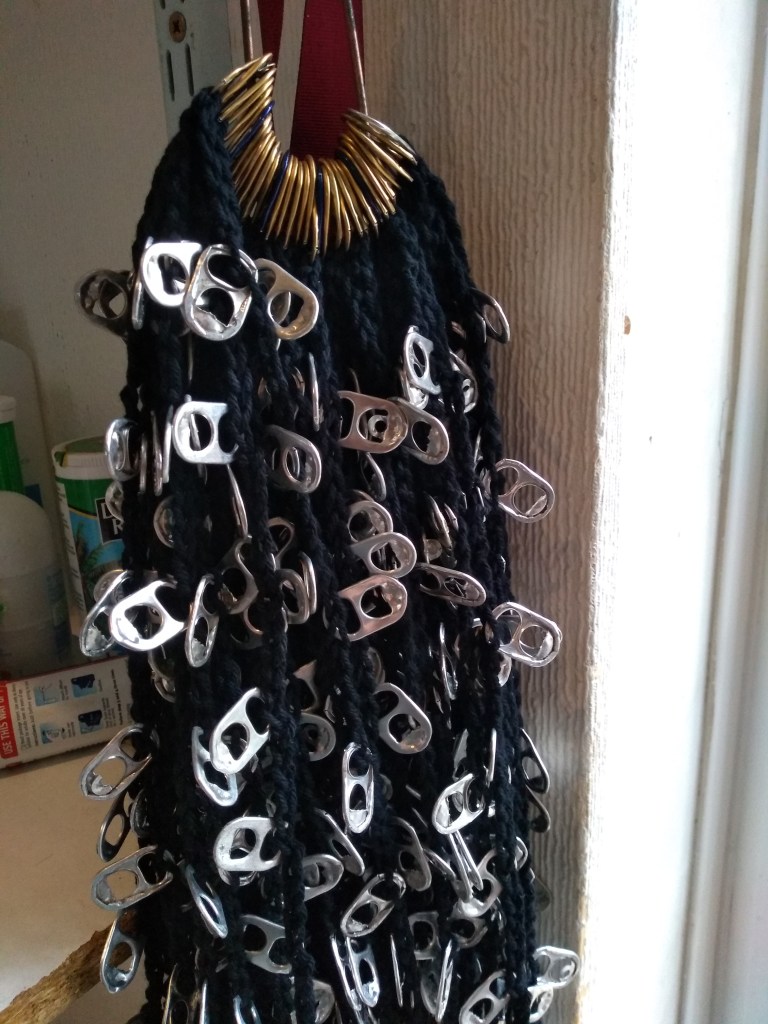
I left finding the timepiece until I had got everything else together. Unpacking the box was an intense experience. I was surprised by the strength of my feeling. Holding up the timepiece, gathered up by the day and week markers (gold and blue ring pulls) it looks bulky and feels light. It smells fusty, like an attic and the patina on the copper pattern hook feels horrible. It’s a feeling I hate.
The glinting of the aluminium makes the soft black of the yarn deeper and formless. I find it visually jarring and weirdly unknown, and I wonder if anyone else would feel like that or if it is just what it represents to me. It occurs to me that I still feel hesitant to document it, but I realise now that it is cause I don’t want to unravel it. The timepiece should be held together in a clump. It is a record of a time that was difficult and it represents the length of that time, but that length is only imposing as a whole. Unravelling the piece minimises the symbolic impact of the bulk of this time measured.
I have crocheted before this piece. The crochet piece from the Future Ruins studio on the BA was made by me imagining a monument for my nomadic people as we navigate a dystopian wasteland. The crochet pieces and live work in the degree show were also made by me, but a me who was imagining myself as someone with something to offer. They were made with confidence.
This timepiece crochet work is made by me as well, but it is a much more vulnerable piece. It feels raw and dark and imposing. There was no character or imagination game between the me that made this work, and the me that was desperately struggling in the pandemic. This is probably the most personal piece of work that I have ever made.
The futility of the situation made me turn to those same witchcraft techniques as in my degree, yet with a much greater sense of seriousness. The ritual of the timepiece helped me in a time when there was nothing left to do. I turned to a magical method to ease my fears and mark the seriousness of the time. The ritual helped get me through and the timepiece holds the discomfort. Its a witness.
A zoomed-in view of a photograph of the timepiece taken in 2020.
In 2017 I submitted my BA dissertation. The extract below is the introduction:
“This essay has came about from problems I am having with my own art practice. I am working with witchery and magic, and I recently incorporated a card from the Tarot into a piece. This meant I got a wild variety of interpretations of the work that I hadn’t anticipated. The Tarot is a big topic. It has a long and variously fantastical history. There are many different schools of thought on how it should be used. Many think that it is magical and that it can tell the future. Others use it as a tool for counselling. There are disagreements in the Tarot reading community about whether you interpret the cards using the guide book, your intuition or your psychic powers. It is gendered in its use: most will think of a female fortune teller. It is gendered in its expertise: most of the systems created around it were made by men. It has a huge non-binary and gender queer sub-culture. There is a story that goes with the Tarot that some see as a guide to self realisation, others see as a tale to help you remember the card meanings. Others relate the archetypes in the cards to Jungian psychology. Some think witchcraft is evil. Some see witchcraft as the territory of silly pagans. As was said in my tutorial, using the images from the Tarot in my work is similar to using images from the Bible: it is a topic that is loaded.
In order to see how it could be done I started to research other artists who had used the Tarot in their work. I found this to be surprisingly difficult. I was interested in the topic so had assumed others would be and that it would be easy to find a comprehensive guide. It seems that although individual artists and exhibitions have been recorded and reviewed there was no writing about them as a group. I decided to compile my research into just that.
That does not mean that this work is comprehensive however. I seem to have collected works and artists who, if not British, are English speaking. I have ignored artists who have simply made a Tarot pack with their art on it. While there is some beautiful and meaningful work out there in the form of Tarot packs, I am interested in those who are dealing with this loaded history that the Tarot has. I have included every artist I have found that does this, and also included group exhibitions that are recreating a Tarot, as that is often related to the Tarot’s place in history and society. I have started with a short introduction to the Tarot for those who are not familiar with it. I have then divided the works I have some across into four sections: The Deck, The Dealer, The Reader and The Wild Card.
In The Deck I discuss artists who have recreated the deck for themselves. In this chapter are Suzzane Treister with the Hexen 2.0 deck, Wayne Burrows with The Holcombe Deck and Francesca Ricci’s Tabula Impressa. I have briefly looked at Salvador Dali’s deck, which is conventional but is of note through being created by such a well known artist.
The chapter The Dealer looks at group exhibitions that have recreated the Tarot deck. This includes two British exhibitions Outrageous Fortune and What Does Our Future Hold? and the video/animation deck that exists online A Mystical Staircase.
The Reader deals with artists who perform Tarot card readings as part of their work. Here I discuss Alejandro Jorodowsky, Leah Wolff and Mark Pillington.
The Wild Card features artists that don’t use the actual pack of cards but use the imagery in their work. Here are Nikki de Sainte Phalle’s Giardino de Tarocchi (a garden), Francis Mckee’s Even The Dead Rise Up (a work of written fiction) and AA Bronson and Scott Treleaven’s Cabine (a fortune tellers tent). “
I started the process of finishing the MA by completing my half-done Counter-mapping project. I had originally started by developing an idea based on exploring children’s understandings of ‘Home’ using maps of the dens that they built. When the COVID 19 pandemic started and the restrictions of lockdown came in it meant everything had to change. My mental health plummeted and I ended up working on a crocheted piece of work that measured the time my partner and I spent shielding in that first lockdown. It didn’t have a name at first but over time I have come to think of it as the Timepiece.
The timepiece was a vulnerable work. One of neurosis and adhd and coping and control-seeking and drive.
“Do you sometimes feel driven, as if by a motor?”
It was a return to the scrap-tics of my degree and there was comfort in that. Talks of reworking my previous project idea to allow for the new restrictions of the pandemic were performative. I couldn’t have organised something that was so far from myself at that time. The level of fragmentation I was experiencing meant that I needed an anchor of ‘severe interest’ to keep me with a project. The timepiece was done in severe self-interest. A pass time, a fidgit, a constant that allowed me to return to the present over and over.
It felt more like magic than any spell I’d made so far. A daunting, incoming storm cloud kind of magic. Bleakness and impending doom. A crowd of cawing ravens circling in the sky. A solid line of text in a diary that would go on for as long as the ‘event’.
During a tutorial DM asked me to document the work and experiment with its form. As a very long piece the possibilities for display seemed endless and a few options were mentioned. When it came to actually starting the documentation, anything I thought of felt a bit frivolous. An idea I had had had been to lay the timepiece around the boundary of the house and garden, but the idea of putting it on the floor outside seemed disrespectful. I was uncomfortable with the feeling and ended up putting the timepiece in a shoe box that eventually made its way to the attic.
Photocopy of inside cover of MA module notebook, 2025
The MA is a lot easier to round up as there was much less content on a much shorter course. I did some academic modules and found out that I was capable of academia, and I did find a few interesting concepts and books to read. After going back to see what it was I had gained to take forwards from the MA, I realise that it was the modules that combined theory and practise that had excited me the most, and the others felt a bit closed ended. I did find the academic way of analysing and critiquing (the essay) a bit restrictive and was happy for the modules that allowed some artistic analysis as well.
The one creative module I was able to take part in and had felt like it was going to be most comfortable, was a huge learning moment for me. I had been feeling at a disadvantage compared to some of the other students on the course who it seemed were more familiar with seminars and long reading lists and I was feeling less out of my depth as we approached the haphazard and relaxed manner of an art module for the group project.
I had done four years at art school and was feeling very well prepared for a creative project but I failed to consider that the rest of the class weren’t. Part of the process at art school and on this group module was the ‘crit’ where you present your idea at different stages and get feedback. It’s an invaluable process and lets you test your piece on an audience along the way, but it can sometimes hurt to have your baby criticised and I had forgotten that I must have built up a tolerance for this over my degree.
When it came to other groups crits I noticed that people were quite shy to talk and did what I normally do to get the ball rolling and spoke up. While my concern was that the other groups got something from the crit process, a lot of the other students just heard my lone criticisms and resented it. I offended one woman so much that she was only able to cope with it by leaving the room when I spoke. This dynamic was noticed by the teaching staff who took responsibility for the other students lack of preparedness and tried to convince the others of the value of constructive criticism but me and my autism made a lot of enemies that day and I still remember how much the contempt I was treated with hurt me. I did notice however that many of the students privately contacted me for their opinions after this so while my opinion was valued, I think the public manner of it wasn’t.
I did have a good time with some other students and did find some motivating ideas while I was there. I was introduced to the artist Jonas Staal and his work. I really enjoyed an external module called ‘Decolonising your Research Methods’ and still find its work helpful. I joined a project called Open Book for a time and got to help some incarcerated young men work on their extend projects for university applications. I wrote an essay where I got annoyed at Freud and his concepts. I started reading and still wrestle with The Order of Things by Foucault and The Practise of Everyday Life by De Certaeu. I did a group project that was fun.
I didn’t get to finish my Countermapping project or do either the Individual Project or the Practical Dissertation, the other available creative modules. I also really wanted to take part in the module Memory and Justice in Post-Conflict Societies. I tried reading some of the reading list for this module and found it very difficult emotionally to continue working on it on my own.
And that’s it. It doesn’t seem that much when I write it all down. What an expensive list.
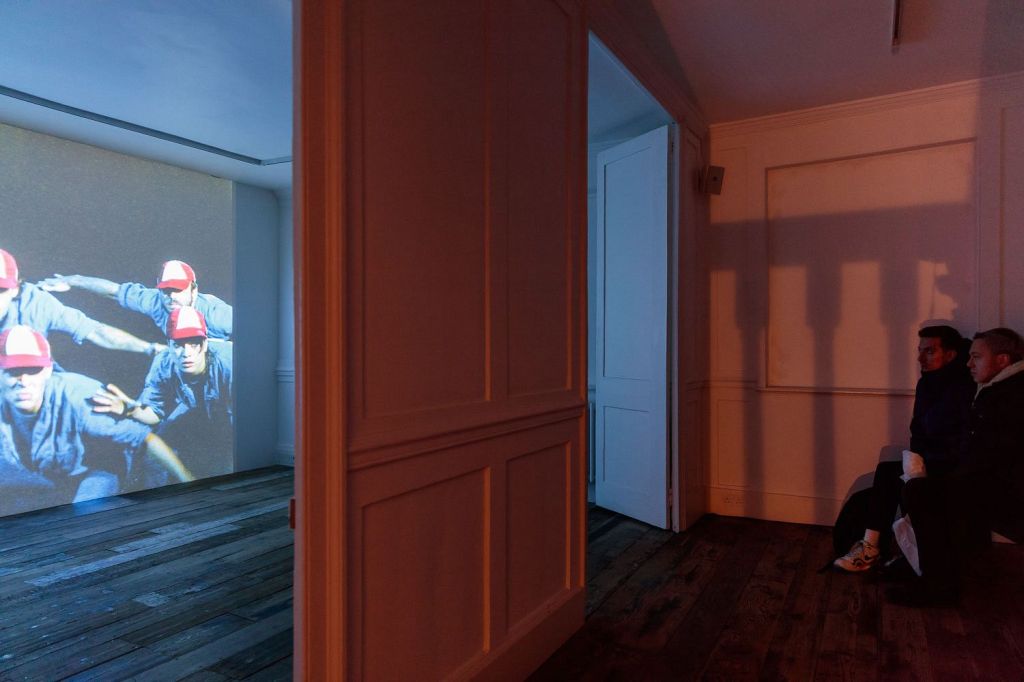
With ‘The Inoperative Community’ curator Dan Kidner and Raven Row have set a challenge. The exhibition comprises of seven permanently installed film pieces and a screening room that shows a weekly programme of an additional 19 films all fitting the description of ‘experimental narrative film and video’. The total running time for the exhibit is just under 50 hours, and whilst Kidner acknowledges that ‘each visitor will only be able to see a fraction of the works on offer’ he also points out that each work ‘benefits from watching from beginning to end’. As if hoping that some might try and wanting to give them a fighting chance, set screening times are given for all the pieces and a guide is provided in the lobby of the gallery and in the thorough booklet that accompanies the exhibition.
The films are all either made in, or hark back to, the long 70’s- a period that ran from the beginning of the student movements and workers revolts of 1968 to their end, and the fear of nuclear war and suspicions of communism that came with the early 80’s. The works have been chosen to illustrate the theme and title of the show which have been taken from the 1983 essay of the same name by Jean-Luc Nancy. The films are said to ‘bear witness’ to what Nancy described as the ‘dissolution, the dislocation or the conflagration of community’.
Probably the most obvious example of this theme is Depositions (2014) by Luke Fowler. This calm film uses footage from BBC archives, mixing news and documentary footage from the 70s and 80s with more recent material to reflect on the dissolution of the travelling communities from the Scottish Highlands. The film is a collage of past and present showing tales, music and skills from the traveller communities alongside footage of medical establishments and equipment, marring the short insight given into the culture of the travellers with a sinister institutional backdrop. The beautiful scenes of Scottish highland landscape and sounds of wildlife do little to remove the sense of foreboding that come with the end of the piece. Its clear how for these highlanders community is as fragile a concept as Nancy implies, here subject to the pressures of and interference from the greater society. The self referential aspects of the film, the footage of the computer search through the BBC archives, cements the separation between the world of the travellers and the present, where our exposure to their culture can come only through searching a database with the right key words.
Erika Beckman’s film You The Better (1983) demonstrates the power relations and complex social systems that the individual faces by using complicated games of indeterminable rules as a metaphor. Watching the group of uniformed players roll, jump and throw a ball around whilst shouting encouragements and insults its hard to tell whether the players are on a team or against each other. The repetitive, melodic and high pitched singing on the soundtrack is simultaneously irritating and compelling, raising the tension of the game and creating a trance-like feeling. The film is projected in a room containing a light box the same shape as the targets the players are trying to hit onscreen. The light box glows in time with those in the film and placed facing the screen it completes the circle that the targets on-screen are moving in, making the spinning ring come out of the film and into the room. The bench in the room is set within the bounds of this circle making the watcher a part of a crowd at a game and not just a viewer of the film. The effectiveness of this prop and the low level of technology it uses is mirrored in the manually drawn special effects that are used. These special effects combined with the bold colour palette of blue, yellow red and green give the feel of an old science fiction film and an aesthetic which appears aimed at children, an idea that is uncomfortable when combined with its ‘House wins’ betting theme. The film, with its tokens of capitalism (houses, money, gambling), seems to be about economic pressures and competition between humans over resources, an obstacle that often sparks the change from community to society.
In Five Year Diary (1981-97) Anne Charlotte Robertson uses the camera as a witness to her life of gardening, family, prescription drugs, driving, cats and mental breakdowns. The film is shot on Super 8 camera with sound on some of the earlier reels having been recorded on a tape recorder and then added, meaning that the sound often doesn’t relate to what is being shown. The Super 8 camera gives the film a grainy, nostalgic quality that has become associated with home video, which in this case is entirely appropriate. The film is split into different reels from different years, and each one follows a period of her life. It’s possible to follow the artist on holiday to the Niagra Falls, listen in to her art school tutorials and watch her struggle to deal with the death of her young niece. The later reels that have been filmed with a camera with a capacity for sound recording and also have commentary that has been added by Robertson at later dates, meaning that you often hear the artist talking over herself: the immediate live recorded voice frantic or excited, whilst the calm and precise removed voice explains what is happening more practically. The visuals are heavily edited, often into a sequence resembling stop motion animation, and the film is full of repetitions. The quick editing combined with the raw sounds of the camera being handled and turned on and off make for intense viewing. Both watching the whole film, or a part of it gives an impression of Robertson’s life that reveals the generally quite private community of an individual, not just their family and friends but their psychologist, teachers and imaginary companions.
As well as the subject of community and its destruction, there is also a theme of length and endurance that runs through the exhibition. The permanently installed films range in length from 25 minutes to 8 hours long with Lav Diaz’s Melancholia (2008) running for 480 minutes. It would require a serious dedication to watch the entire exhibition. Whether it is working out how to watch the whole of Melancholia without having to bring a packed lunch, dividing the film up into daily slots to watch like a slow-moving, eerily sad and angry soap opera perhaps or gritting the teeth to sit through the relentless conversation that is often so abstract it is incomprehensible (once translated and sub-titled) in Albert Serra’s Els Noms De Crist (2010) you would be rising to the challenge and taking part in the trial as asked. The subject of Serra’s Els Noms De Crist is the making of a difficult film and the length and subject are mirrored in the endurance that was needed for some of the projects displayed: Leslie Thornton’s Peggy and Fred in Hell: Folding is a project started in 1984 which is still in process; the full Five Year Diary is 37 hours long and the project took Robertson 16 years to complete.
The screening room that is at the back of the gallery shows a themed selection of films each day of the week giving the viewer the possibility of a marathon viewing session from Wednesday to Sunday. The films shown in the screening room include some that are more recognisable to the cinema buff, mostly being known as pieces of experimental cinema rather than film art. Included in the programmes are Grimonprez’s dial H-I-S-T-O-R-Y (1997), films by Jean-Pierre Gorin, Jean-Luc Goddard and Pere Portabella. The presentation of these films in this cinema environment sets them apart from those on permanent display. There is a very strong cinema/art divide that apparently encourages the audience to treat the two settings differently: staying to watch a whole film in the screening room having made the commitment to find a seat in the dark cinema (an environment associated with watching a film in its entirety), and wandering in and out of the films that are on permanent display each in their own lighter room with sofas instead of chairs. In the curatorial statement Dan Kidner talks about the increasing cross over between avant-garde film makers and artists’ films, saying that each group have been looking to the other for ‘conceptual gestures’, ‘aesthetics’ and ‘political preoccupations’. The gallery and curator have taken care ‘not to fetishise film projection and cinema’ by showing all works digitally. Whilst it seems the intention of this is to bring all the films to the same level whether art or cinema, it has more of a noticeable effect of flattening those films that clearly originally made in a different medium. It is not unusual to go and see an old film that has been digitalised so in the cinema setting of the screening room the effect is not as noticeable as when Five Year Diary, a work clearly shot on Super 8 film and presented in the reels of that format complete even with the clicking noise of the camera and the sound of the film whirring through it, is converted and beamed from a digital projector, silently lurking above the heads of the watchers.
Knowing that the film has been digitalised is also disruptive in Stuart Marshall’s Journal of the Plague Year (1984). The piece takes the form of five cathode ray televisions embedded in a wall with short dividers between them. Each television shows a very still film showing part of the narrative of the Plague Year, in this instance being the Aids crisis in 1983/84. Focusing on the different representations of gay men from the 20th century the films show the homophobic reporting of the Aids crisis in Britain in the form of newspaper headlines, a restful video of a man sleeping and images of Flossenburg concentration camp where the Nazis executed homosexuals and dissidents. The shiny surface of the televisions is an unmistakeable familiarity from an earlier era for those who can remember and the work is very time specific. Digital images are an anachronism in such a piece. It is inevitable however that work of this kind would be have to be digitalised at some point for the conservation of the film.
Despite this attempt to keep the medium of the pieces from creating a favouritism, the different settings of the two groups of films do keep them apart and this contrast works against the digitalisation and its attempt to discourage the ‘kind of distracted viewing practiced by visitors to galleries’. Showing these films in an art gallery means that encouraging viewers to watch the films in their entirety would be going against much of the convention of gallery viewing, even for the regular visitors to Raven Row who might be used to less commercially viable art and a more specialist and complete form of exhibition. Whilst the exhibition has a few clear themes running through it (the work is all experimental film, the theme of breakdown of community and the reoccurring variations on length and endurance) the different methods of viewing the films do create a fragmentary experience. There is the division between the cinema and the art, as well as the difficulty of sitting and watching a film knowing that just upstairs/downstairs/around the corner are other films that you might be enjoying more or understanding better. The conceptually wide-ranging and dense Nancy essay that the exhibition is based on provides a context for this fragmentation however, as well as any other ‘dislocations’ that can be found in the show, making it impossible to tell whether they are failings or clever illustrations to a point. Every viewer will come away with a different impression of the show and the works involved, and their idea of what they have shared with every other visitor will be as unique as everyone’s experience of their own communities.
I did my BA at London Metropolitan and finished in 2017. At the time the art school was in Whitechapel where I worked managing a bookshop. On the tour around the buildings there I could see that the workshops and studios were well equipped and there was lots to work with. I spent four years there while I did the foundation and degree and I enjoyed my time at the school.
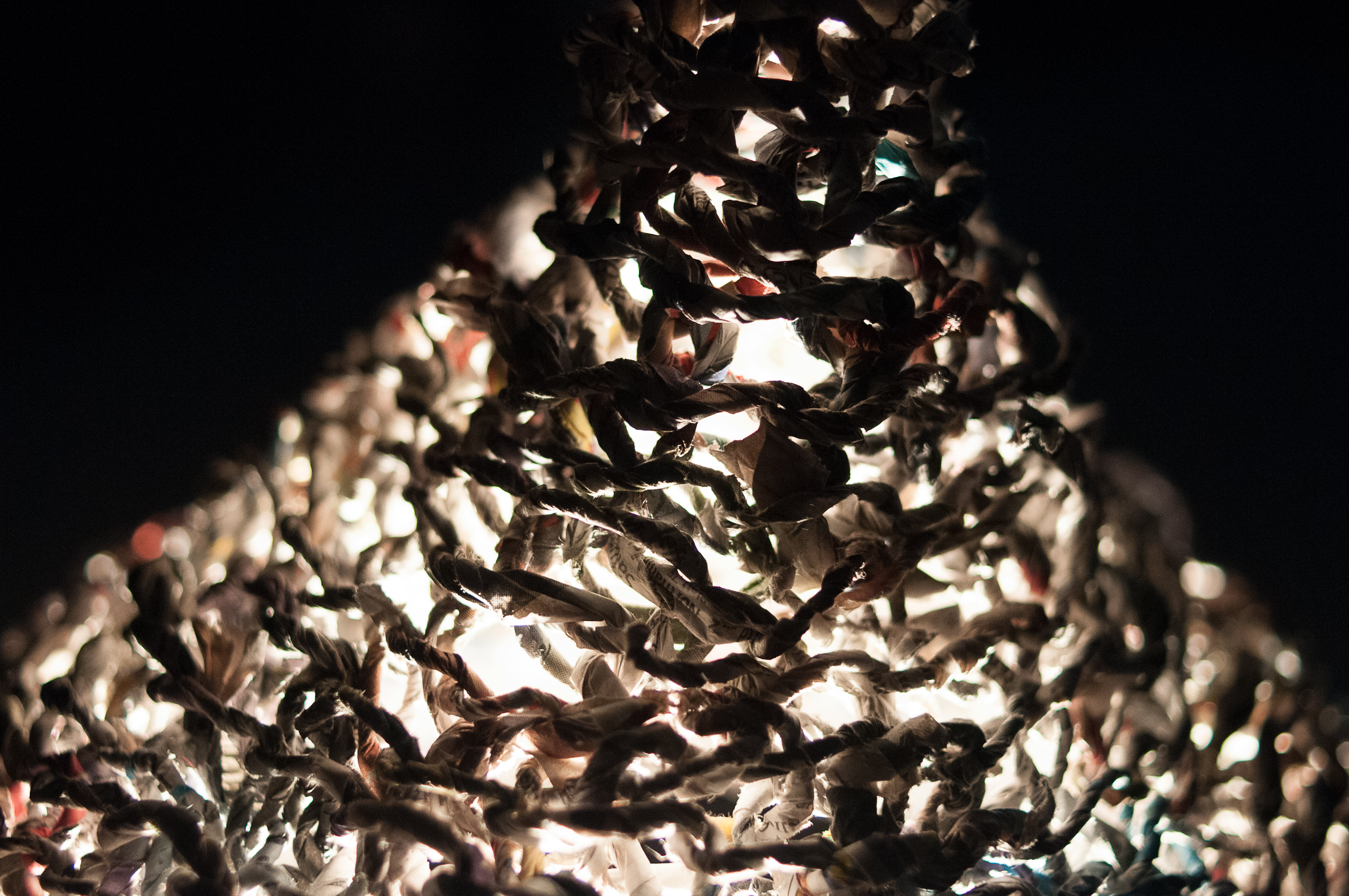
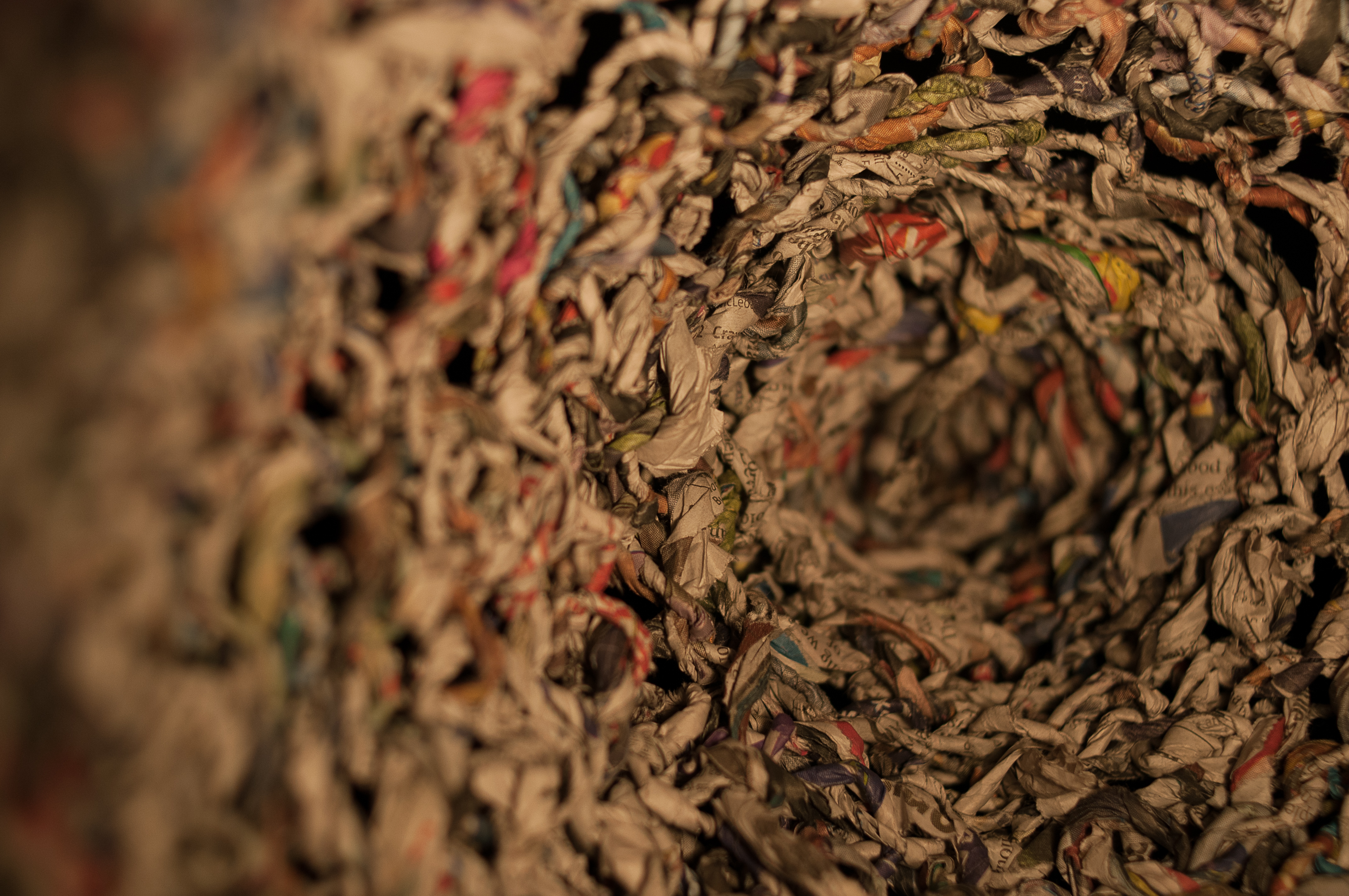
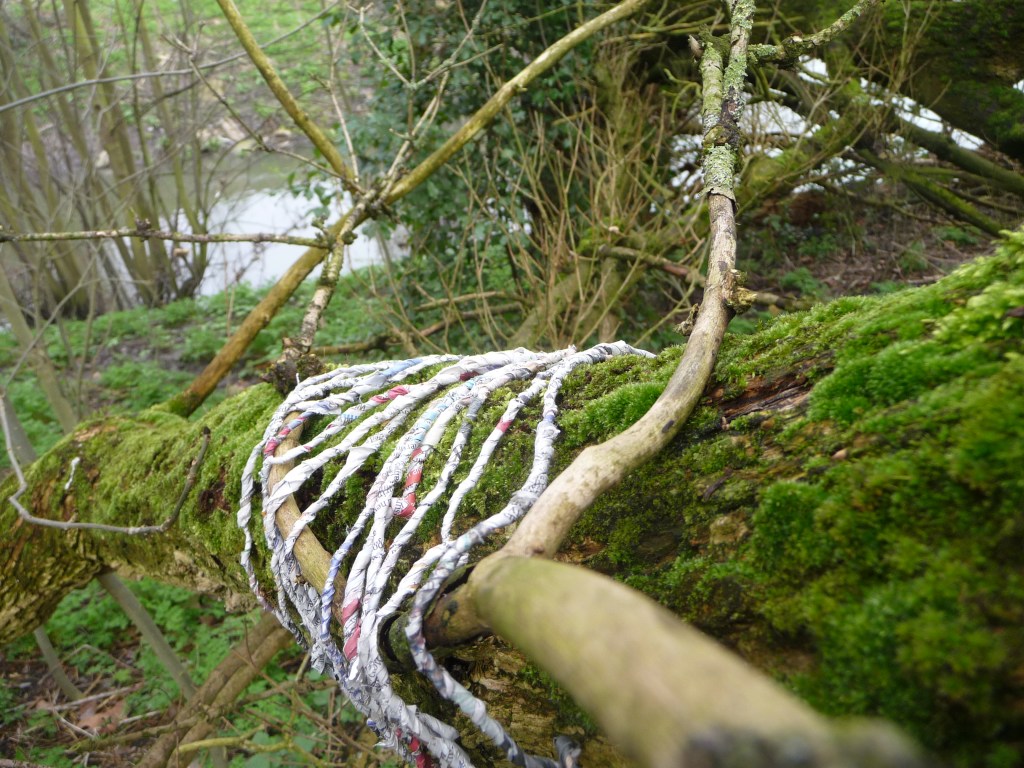
The foundation and first year were well guided and through those guided activities I found some techniques and interest that continued to reappear through my work going forwards. I can’t remember how I landed on it but at some point I made newspaper into yarn. I made nets, crocheted and knots and enjoyed the material.
Crocheted newspaper yarn shape with light source insideInside of crocheted newspaper yarn shapeCrocheted newspaper yarn shape lit from inside
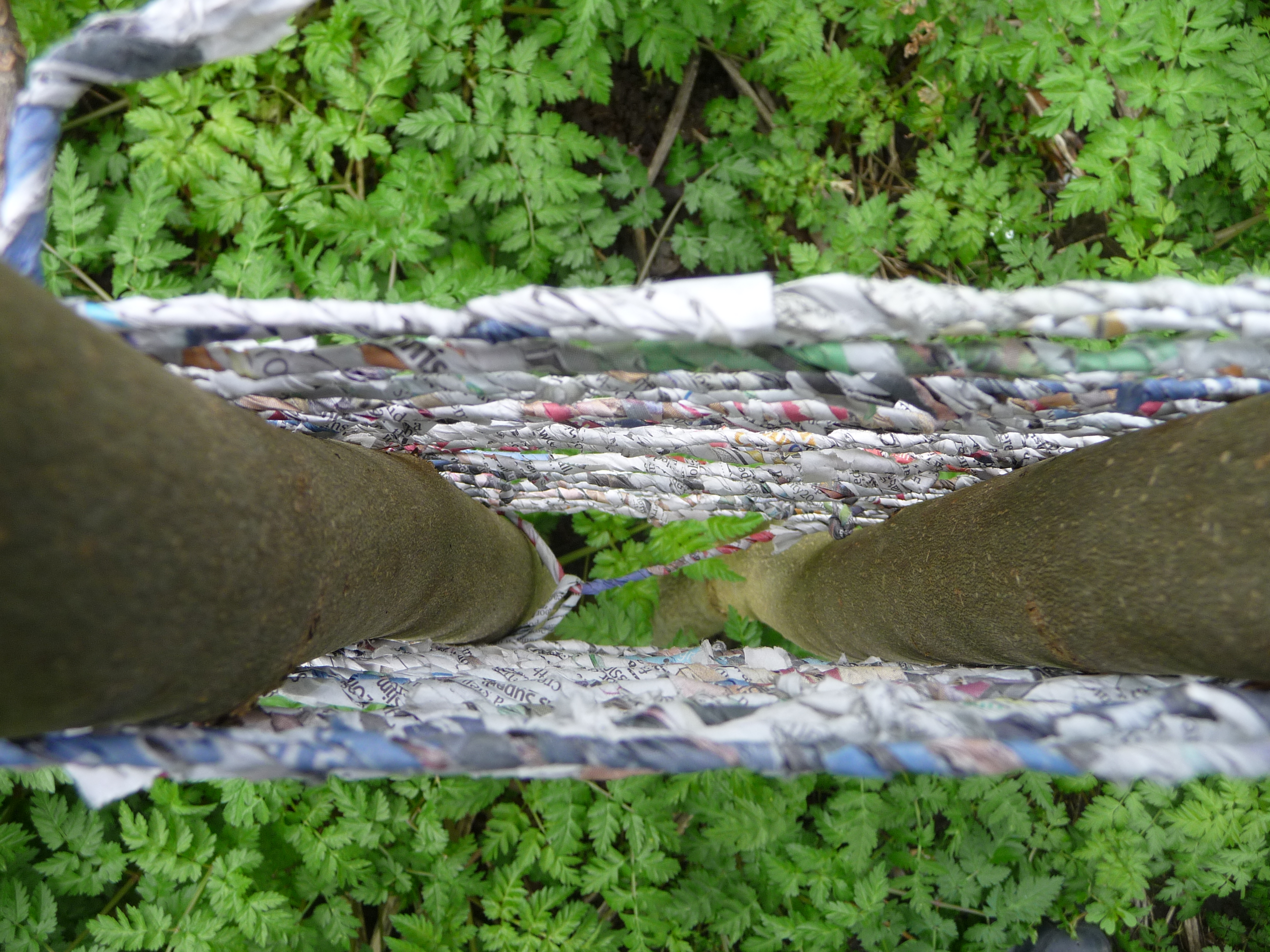
Newspaper yarn wrapped around a mossy tree
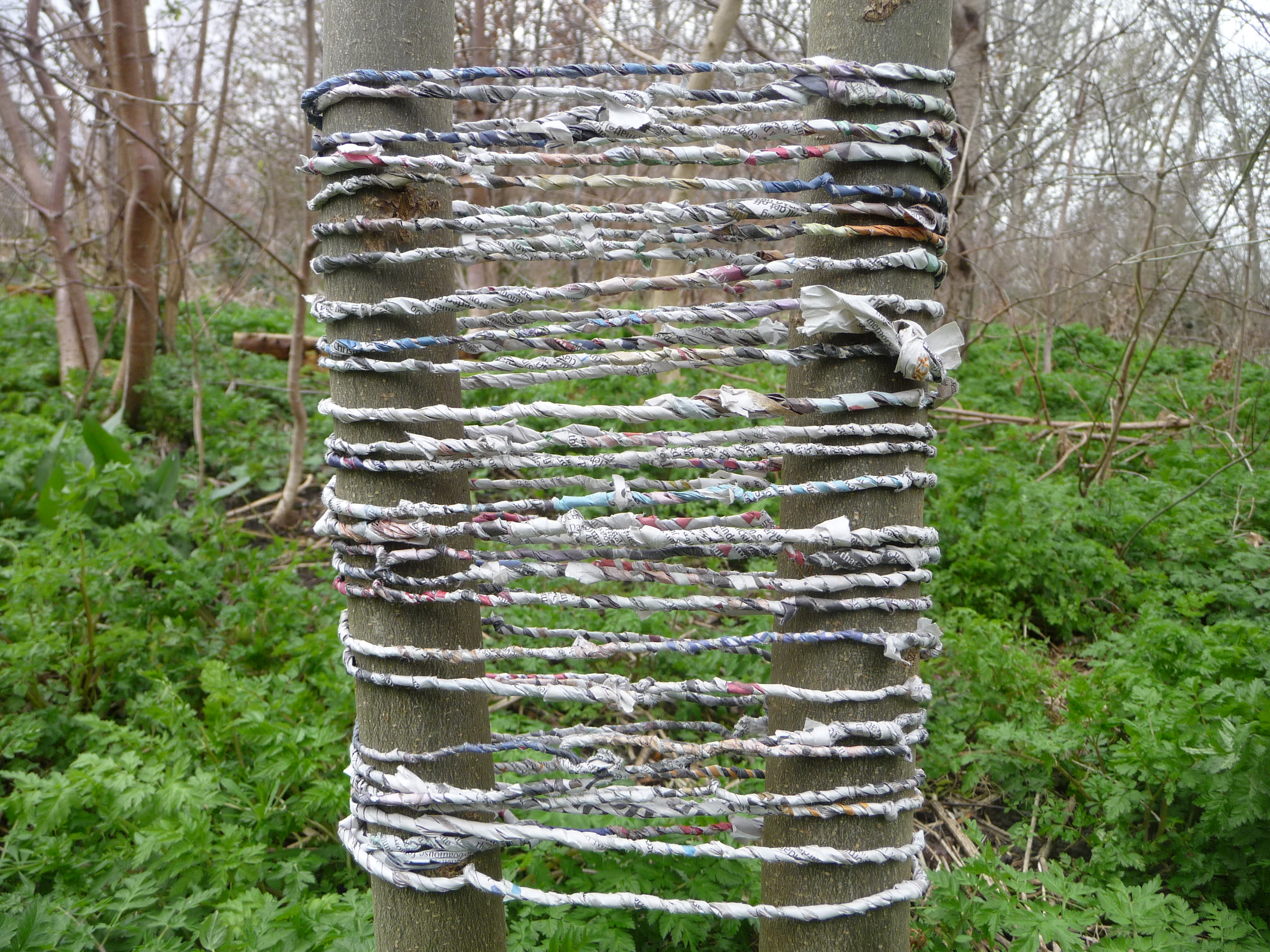
Newspaper yarn wrapped around two tree trunks
Newspaper yarn wrapped around two tree trunks, but from a different angle this time
In the third and fourth years we were given a choice of ‘studios’ which were each run by a different team of tutors. In the third year I took part in a studio called Future Ruins that was run by artists Pil and Galia Kolektiv and Matthew McQuillan and I thrived. I tried some techniques that I hadn’t before and took opportunities.
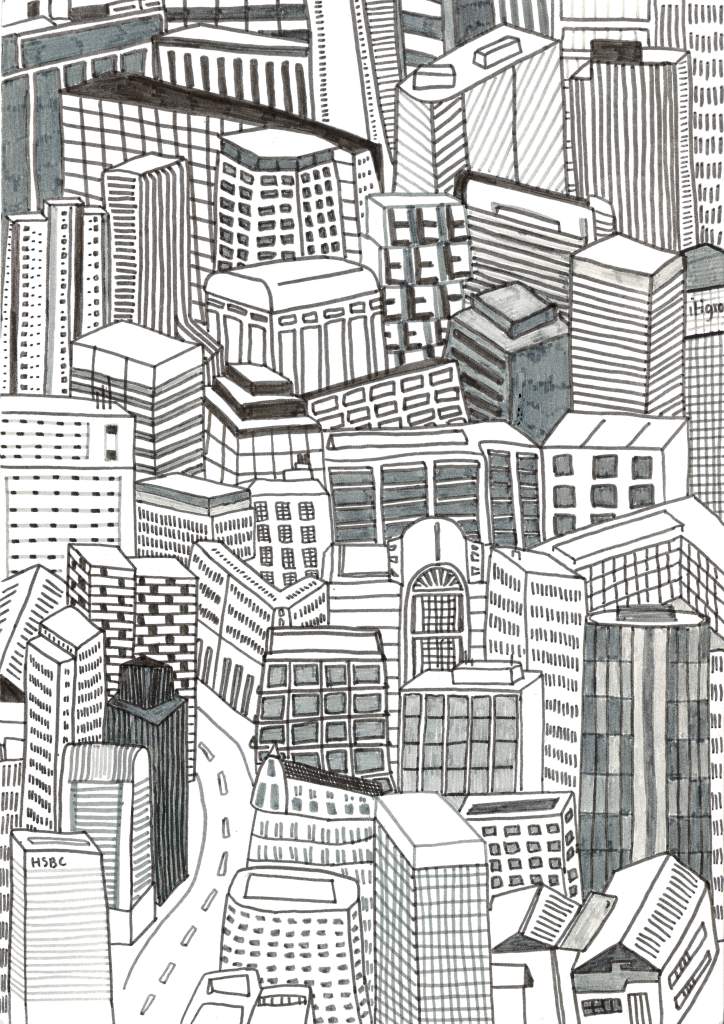
This school year was set against the backdrop of the continuing gentrification of the area of Whitechapel and Aldgate, and it became personal when we heard that the art and architecture department buildings would be sold. I thought and read a lot about class and gentrification, and drew a lot of buildings. It was one of these sketches that I won a competition with and as a result had the work printed and fly-posted around Shoreditch and Aldgate.
Tower blocks and skyscrapers drawn in felt tip pen, 2015
Printed building sketch flyposted on Commercial Street in 2016
I printed a version of this drawing as a performance at a school event, and also worked with audio and video for the first time for my final piece. I found myself in a position where the idea I had had didn’t work in the format I was planning. I learnt to let go of the old idea and move forwards with what I had, accepting that I didn’t know where I would end up. This experience was formative for me and allowed me to be a more honest artist.
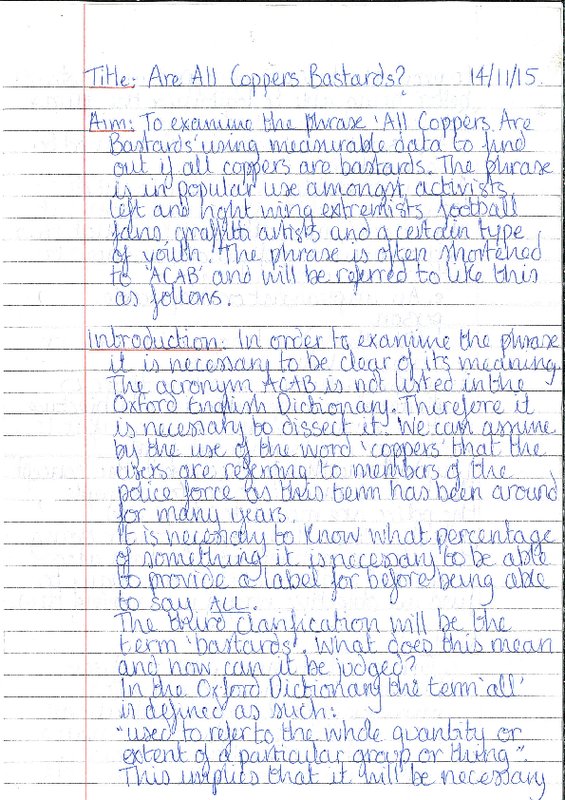
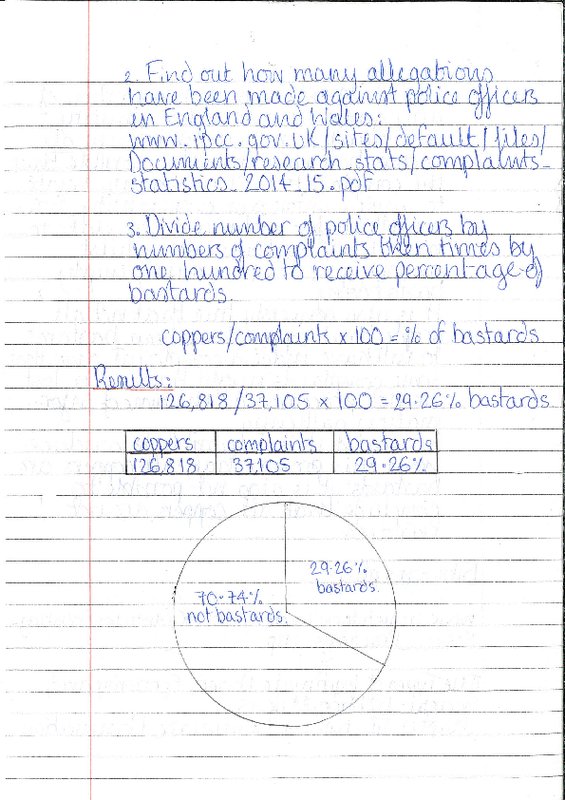
One of the first pieces of work I did that year was this essay I wrote. To quote myself at the time “I was glad however, that they understood the format was not serious and I found a name for this kind of thing: inappropriate discourse.”
Page 1 of Are All Coppers Bastards? An essay 2015
Page 2 of Are All Coppers Bastards? An essay 2015
Page 3 of Are All Coppers Bastards? An essay 2015
Page 4 of Are All Coppers Bastards? An essay 2015
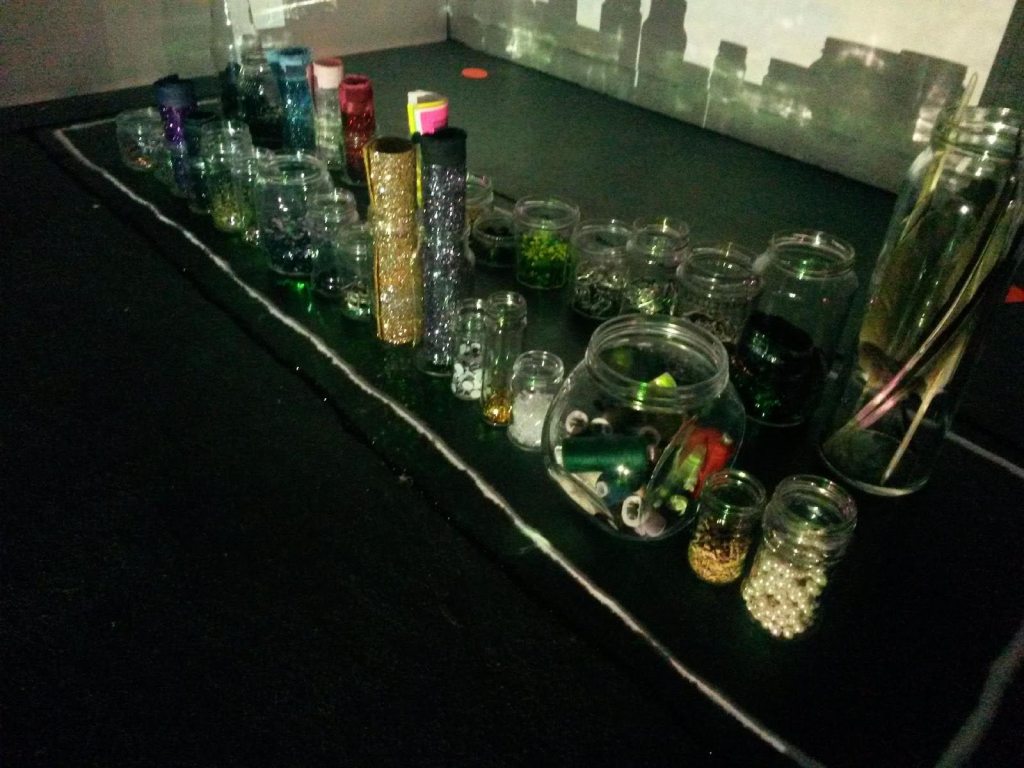
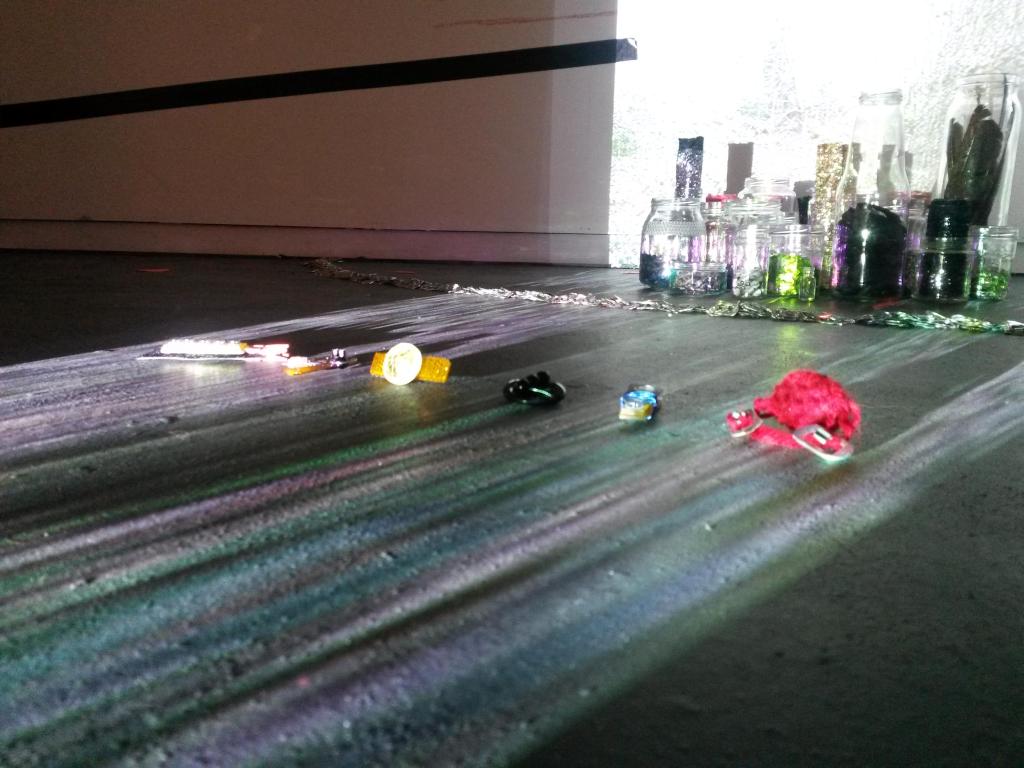
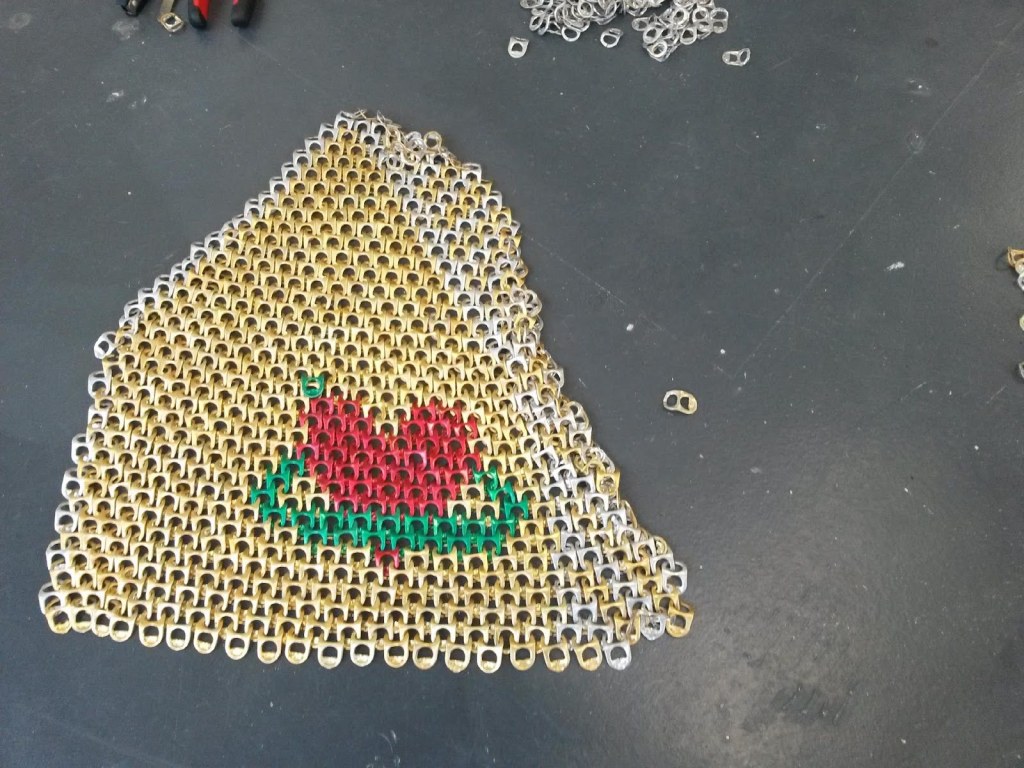
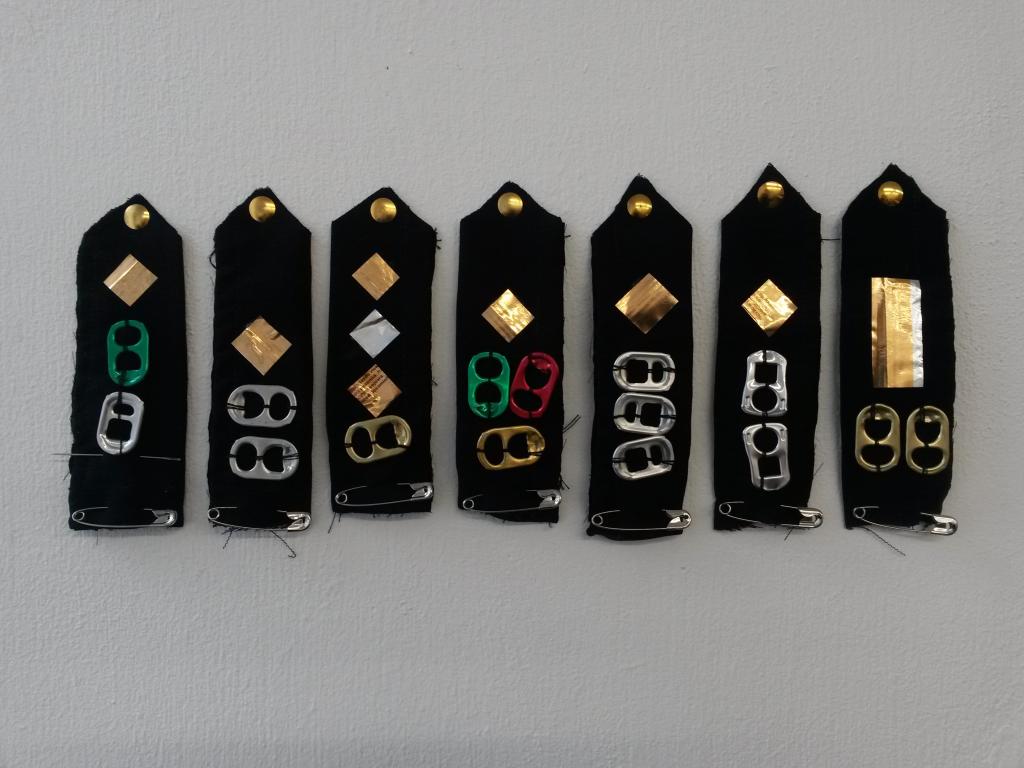
Another work that was very pivotal to my practice, yet I can’t find a photo of it anywhere, was The Monument. In the Future Ruins studio we were given a briefing to create a monument that would be made in the future to a past event. I imagine these future people in a world of ruined skyscrapers and made a monument was a string of crocheted yarn periodically marked with ring pulls. It was intended to dangle and twinkle and jingle in the wind, and to be easy to transport. I continued this exact technique on the MA towards a very different outcome.
The discussions I had around these works brought me to three important concepts: defamiliarisation, inappropriate discourse and overidentification. I also keep going back to In Defense of the Poor Image. I continue to think around these topics.
The next year I took part in Black Box run by Galia Kolektiv, Patrick Ward and Nicky McCarthy and kept on thriving. This school year ran in tandem to Trump’s campaign, election and first few months in office. The idea of politically relevant, let alone politically motivating, artwork seemed like reaching for the stars. The feeling of hope I had generated for myself by making some subtle inroads in to political art over the last year had vanished and been replaced with a sense of futility. In the same way that I imagine conspiracy theorists do, I took refuge in a world of invented esoteric knowledge and imagined power. I turned to witchcraft.
To quote myself at the time: “I’m sick of trying to fix things. I’m sick of reacting. I’m sick of being defensive. I’ve given up bad habits and now I’m on the offensive. A spell, a curse, an action. I don’t need much, I work with what I’ve got. Mostly I use my love and my hate. Mostly I use my admiration and my vitriol.”
It is a testament to how caught up in the work I was that I had very little documentation. the pictures I have below are some of the only records I have of the work of this time.
Photograph of installation RAW MD, 2017Photograph of installation RAW MD, 2017
Photograph of installation RAW MD, 2017Photograph of installation RAW MD, 2017
Siege curtain, 2016A spell against police brutality, 2016
A spell to protect you from what you were asking for, 2016
A spell to protect you from what you were asking for, 2016
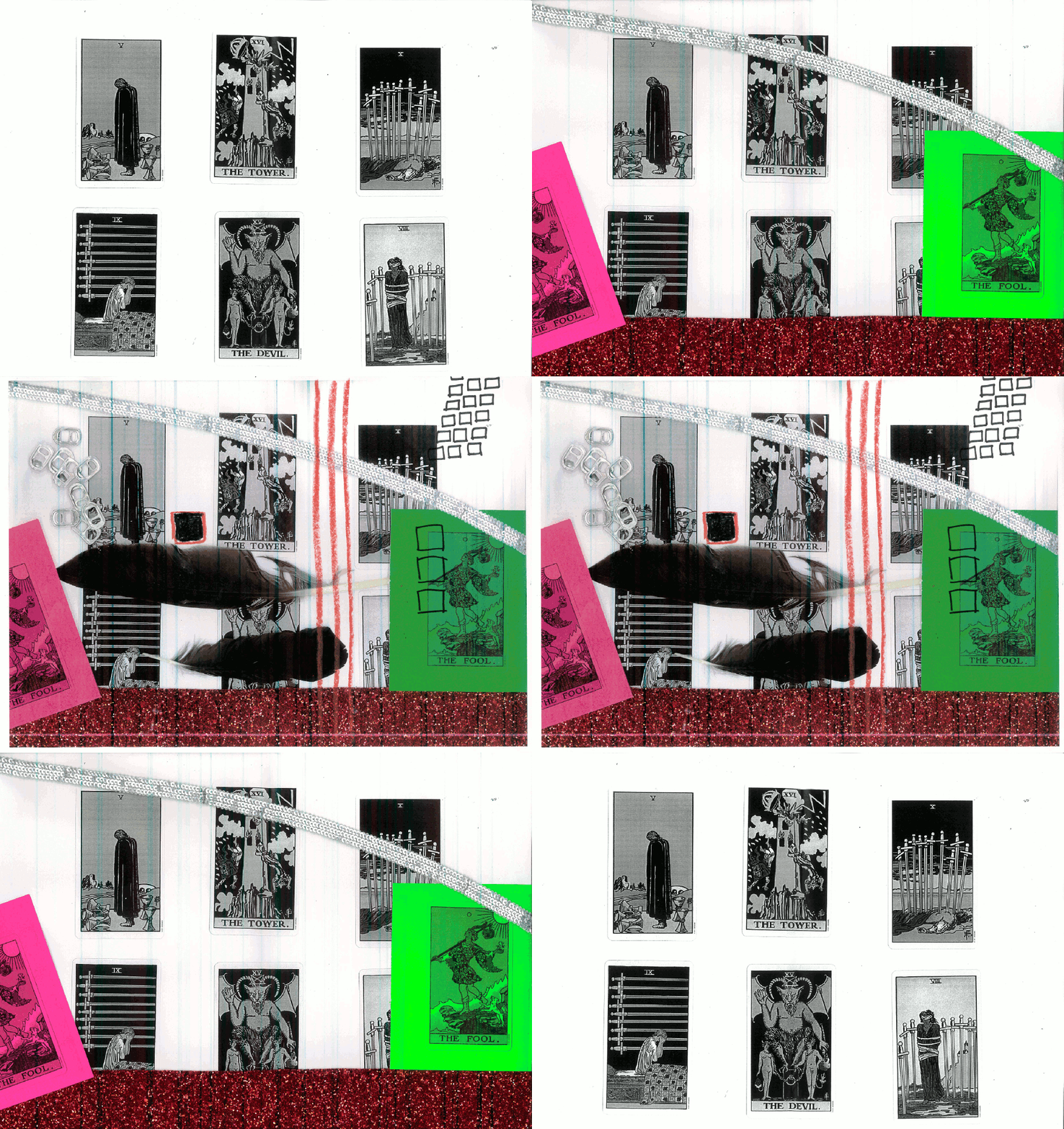
The gifs below are not my favourite work, and are nauseating to watch, but they do display the elements of the work that were the most frequently seen: tarot cards, ring pulls, reused images, shiny things, photocopying, annotation.
My participation in those last two years on this course was such an intellectually stimulating time for me and I was introduced to new concepts that forced some hard thinking. The anarchist in me loved it. I will always be especially grateful to Galia Kolektiv who thought enough of me to introduce me to over-identification, and also to Pil Kolektiv who saw enough of me to warn me off it. I was touched by how much Galia and Pil Kolektiv considered all their students capable of, and I found it encouraging. I found the tutors I worked with at the school mostly very genuine in their enthusiam to help me learn and I am very glad I waited to go to university until I was together enough to appreciate the opportunity.



















 Unfinished MA