A review during the fine art BA in 2015:
The Inoperative Community
3rd December 2015- 14th Feb 2015
Raven Row, 56 Artillery Lane, London E1 7LS
With ‘The Inoperative Community’ curator Dan Kidner and Raven Row have set a challenge. The exhibition comprises of seven permanently installed film pieces and a screening room that shows a weekly programme of an additional 19 films all fitting the description of ‘experimental narrative film and video’. The total running time for the exhibit is just under 50 hours, and whilst Kidner acknowledges that ‘each visitor will only be able to see a fraction of the works on offer’ he also points out that each work ‘benefits from watching from beginning to end’. As if hoping that
some might try and wanting to give them a fighting chance, set screening times are given for all the pieces and a guide is provided in the lobby of the gallery and in the thorough booklet that accompanies the exhibition.
The films are all either made in, or hark back to, the long 70’s- a period that ran from the beginning of the student movements and workers revolts of 1968 to their end, and the fear of nuclear war and suspicions of communism that came with the early 80’s. The works have been chosen to illustrate the theme and title of the show which have been taken from the 1983 essay of the same name by Jean-Luc Nancy. The films are said to ‘bear witness’ to what Nancy described as the ‘dissolution, the dislocation or the conflagration of community’.
Probably the most obvious example of this theme is Depositions (2014) by Luke Fowler. This calm film uses footage from BBC archives, mixing news and documentary footage from the 70s and 80s with more recent material to reflect on the dissolution of the travelling communities from the Scottish Highlands. The film is a collage of past and present showing tales, music and skills from
the traveller communities alongside footage of medical establishments and equipment, marring the short insight given into the culture of the travellers with a sinister institutional backdrop. The beautiful scenes of Scottish highland landscape and sounds of wildlife do little to remove the sense of foreboding that come with the end of the piece. Its clear how for these highlanders community is as fragile a concept as Nancy implies, here subject to the pressures of and interference from the greater society. The self referential aspects of the film, the footage of the computer search through the BBC archives, cements the separation between the world of the travellers and the present, where our exposure to their culture can come only through searching a database with the right key words.
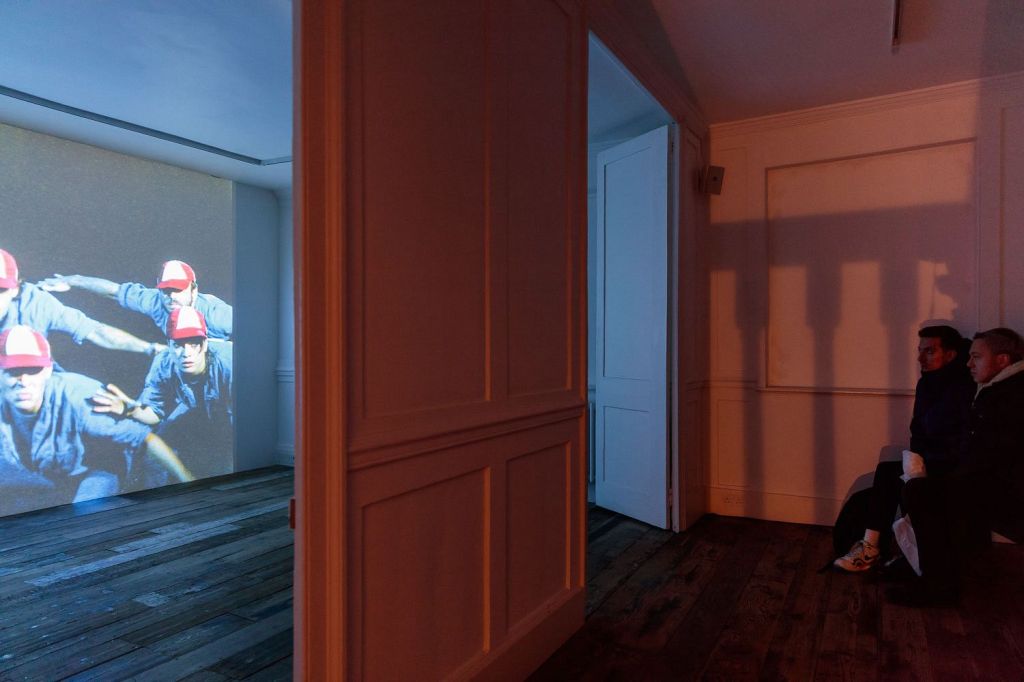
Erika Beckman’s film You The Better (1983) demonstrates the power relations and complex social systems that the individual faces by using complicated games of indeterminable rules as a metaphor. Watching the group of uniformed players roll, jump and throw a ball around whilst shouting encouragements and insults its hard to tell whether the players are on a team or against each other. The repetitive, melodic and high pitched singing on the soundtrack is simultaneously irritating and compelling, raising the tension of the game and creating a trance-like feeling. The film is projected in a room containing a light box the same shape as the targets the players are trying to hit onscreen. The light box glows in time with those in the film and placed facing the screen it completes the circle that the targets on-screen are moving in, making the spinning ring come out of the film and into the room. The bench in the room is set within the bounds of this circle making the watcher a part of a crowd at a game and not just a viewer of the film. The effectiveness of this prop and the low level of technology it uses is mirrored in the manually drawn special effects that are used. These special effects combined with the bold colour palette of blue, yellow red and green give the feel of an old science fiction film and an aesthetic which appears aimed at children, an idea that is uncomfortable when combined with its ‘House wins’ betting theme. The film, with its tokens of capitalism (houses, money, gambling), seems to be about economic pressures and competition between humans over resources, an obstacle that often sparks the change from community to society.
In Five Year Diary (1981-97) Anne Charlotte Robertson uses the camera as a witness to her life of gardening, family, prescription drugs, driving, cats and mental breakdowns. The film is shot on Super 8 camera with sound on some of the earlier reels having been recorded on a tape recorder and then added, meaning that the sound often doesn’t relate to what is being shown. The Super 8 camera gives the film a grainy, nostalgic quality that has become associated with home video, which in this case is entirely appropriate. The film is split into different reels from different years, and each one follows a period of her life. It’s possible to follow the artist on holiday to the Niagra Falls, listen in to her art school tutorials and watch her struggle to deal with the death of her young niece. The later reels that have been filmed with a camera with a capacity for sound recording and also have commentary that has been added by Robertson at later dates, meaning that you often hear the artist talking over herself: the immediate live recorded voice frantic or excited, whilst the calm and precise removed voice explains what is happening more practically. The visuals are heavily edited, often into a sequence resembling stop motion animation, and the film is full of repetitions. The quick editing combined with the raw sounds of the camera being handled and turned on and off make for intense viewing. Both watching the whole film, or a part of it gives an impression of Robertson’s life that reveals the generally quite private community of an individual, not just their family and friends but their psychologist, teachers and imaginary companions.
As well as the subject of community and its destruction, there is also a theme of length and endurance that runs through the exhibition. The permanently installed films range in length from 25 minutes to 8 hours long with Lav Diaz’s Melancholia (2008) running for 480 minutes. It would require a serious dedication to watch the entire exhibition. Whether it is working out how to watch the whole of Melancholia without having to bring a packed lunch, dividing the film up into daily slots to watch like a slow-moving, eerily sad and angry soap opera perhaps or gritting the teeth to sit through the relentless conversation that is often so abstract it is incomprehensible (once translated and sub-titled) in Albert Serra’s Els Noms De Crist (2010) you would be rising to the challenge and taking part in the trial as asked. The subject of Serra’s Els Noms De Crist is the making of a difficult film and the length and subject are mirrored in the endurance that was needed for some of the projects displayed: Leslie Thornton’s Peggy and Fred in Hell: Folding is a project started in 1984 which is still in process; the full Five Year Diary is 37 hours long and the project took Robertson 16 years to complete.
The screening room that is at the back of the gallery shows a themed selection of films each day of the week giving the viewer the possibility of a marathon viewing session from Wednesday to Sunday. The films shown in the screening room include some that are more recognisable to the cinema buff, mostly being known as pieces of experimental cinema rather than film art. Included in
the programmes are Grimonprez’s dial H-I-S-T-O-R-Y (1997), films by Jean-Pierre Gorin, Jean-Luc Goddard and Pere Portabella. The presentation of these films in this cinema environment sets them apart from those on permanent display. There is a very strong cinema/art divide that apparently encourages the audience to treat the two settings differently: staying to watch a whole film in the screening room having made the commitment to find a seat in the dark cinema (an environment associated with watching a film in its entirety), and wandering in and out of the films that are on permanent display each in their own lighter room with sofas instead of chairs. In the curatorial statement Dan Kidner talks about the increasing cross over between avant-garde film makers and artists’ films, saying that each group have been looking to the other for ‘conceptual gestures’, ‘aesthetics’ and ‘political preoccupations’. The gallery and curator have taken care ‘not to fetishise film projection and cinema’ by showing all works digitally. Whilst it seems the intention of this is to bring all the films to the same level whether art or cinema, it has more of a noticeable effect of flattening those films that clearly originally made in a different medium. It is not unusual to go and see an old film that has been digitalised so in the cinema setting of the screening room the effect is not as noticeable as when Five Year Diary, a work clearly shot on Super 8 film and presented in the reels of that format complete even with the clicking noise of the camera and the sound of the film whirring through it, is converted and beamed from a digital projector, silently lurking above the heads of the watchers.
Knowing that the film has been digitalised is also disruptive in Stuart Marshall’s Journal of the Plague Year (1984). The piece takes the form of five cathode ray televisions embedded in a wall with short dividers between them. Each television shows a very still film showing part of the narrative of the Plague Year, in this instance being the Aids crisis in 1983/84. Focusing on the different representations of gay men from the 20th century the films show the homophobic reporting of the Aids crisis in Britain in the form of newspaper headlines, a restful video of a man sleeping and images of Flossenburg concentration camp where the Nazis executed homosexuals and dissidents. The shiny surface of the televisions is an unmistakeable familiarity from an earlier era for those who can remember and the work is very time specific. Digital images are an anachronism in such a piece. It is inevitable however that work of this kind would be have to be digitalised at some point for the conservation of the film.
Despite this attempt to keep the medium of the pieces from creating a favouritism, the different settings of the two groups of films do keep them apart and this contrast works against the digitalisation and its attempt to discourage the ‘kind of distracted viewing practiced by visitors to galleries’. Showing these films in an art gallery means that encouraging viewers to watch the films
in their entirety would be going against much of the convention of gallery viewing, even for the regular visitors to Raven Row who might be used to less commercially viable art and a more specialist and complete form of exhibition. Whilst the exhibition has a few clear themes running through it (the work is all experimental film, the theme of breakdown of community and the
reoccurring variations on length and endurance) the different methods of viewing the films do create a fragmentary experience. There is the division between the cinema and the art, as well as the difficulty of sitting and watching a film knowing that just upstairs/downstairs/around the corner are other films that you might be enjoying more or understanding better. The conceptually wide-ranging and dense Nancy essay that the exhibition is based on provides a context for this fragmentation however, as well as any other ‘dislocations’ that can be found in the show, making it impossible to tell whether they are failings or clever illustrations to a point. Every viewer will come away with a different impression of the show and the works involved, and their idea of what they have shared with every other visitor will be as unique as everyone’s experience of their own communities.
 Unfinished MA
Leave a comment